


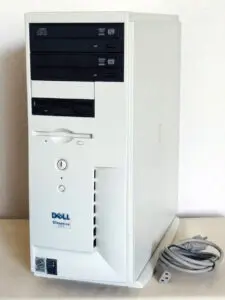
Dell Dimension 4100 PIII Retro Mod
The Final Configuration
- Intel Pentium III @ 866 MHz
- 512MB PC133 RAM
- 20GB IDE HDD (secondary)
- 1TB SATA HDD (primary via IDE converter)
- SATA controller card
- 3.5″ floppy drive
- DVD-RW SATA drive
- DVD-RW EIDE drive
- USB 2.0 PCI card (with one faulty port)
- Sound Blaster Live 5.1
- Gigabyte LAN card
- GeForce MX 4000 512MB GPU
There’s something uniquely satisfying about reviving late-90s / early-2000s hardware, not as a museum pieces, but as something that actually works for Retro Gaming today. This particular build started life as a stock Dell Dimension 4100, powered by a Pentium III, and ended up as a carefully balanced retro-modern hybrid designed to run both Windows 98 SE and Windows XP Pro reliably.
This system had all the hallmarks of early 2000s hardware: aging thermal paste, dusty internals, and the typical mix of IDE drives and PCI expansion cards.
Before anything else, I stripped down this Dimension 4100 and thoroughly cleaned it. Both the CPU and GPU were repasted during this process. That alone made a noticeable difference, Pentium III chips don’t run particularly hot, but decades-old thermal compound certainly doesn’t help stability.
My goal wasn’t to keep everything period-correct, it was to make the system stable and usable for “Old School” Gaming without losing its identity.
One of the biggest changes came from storage. Instead of relying solely on aging IDE drives, I used EIDE-to-SATA converters so S.M.A.R.T. (Self-Monitoring, Analysis, and Reporting Technology) could be used to verify drive integrity. This way I could use a modern 1TB SATA drive and DVD-RW Optical Drive to coexist alongside a smaller 20GB IDE disk used for windows 98 SE. The result was a system that boots and behaves like a classic machine but benefits from vastly improved storage reliability and capacity under windows XP.
Expansion and Modern Touches
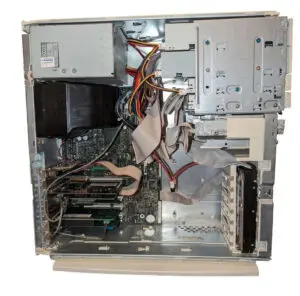
While the core remained classic, a few upgrades quietly transformed usability:
- A USB 2.0 expansion card brought faster external connectivity, even with one damaged port.
- Gigabyte LAN card ensured reliable networking beyond what the original hardware could offer.
- A Sound Blaster Live! 5.1 card delivered authentic, hardware-accelerated audio—an essential part of the retro PC experience.
- Dual DVD-RW optical drives, one IDE and one SATA, added flexibility for software installs and media.
- PCI SATA Expansion card (only worked in windows XP due to drivers).
AGP Graphics Solution
The graphics solution leaned slightly beyond strict period correctness with a GeForce MX 4000 (512MB). While not native to the Pentium III era, it provided broader compatibility and smoother performance across both Windows 98SE and Windows XP.
Dual-Boot Environment
The system was configured to dual-boot:
- Windows 98 Second Edition for legacy gaming and software
- Windows XP Professional for a more stable and flexible experience
Both operating systems were fully installed, updated with the correct drivers. Switching between the two operating systems is a simple matter of entering the BIOS and changing the Boot Drive. Unfortunately there wasn’t a functional method to do it within the XP boot Loader due to hardware limitations of the PIII.
Final Presentation
This system was built with the intent to sell, so it wasn’t just a Dell Dimension 4100 PIII Tower, it was a complete, ready-to-use setup:
- Era-appropriate mouse and keyboard included
- Power and video cables provided
- Installation media and boot disks packaged alongside
- Documentation outlining configuration and usage
A monitor and speakers were intentionally left out, allowing flexibility for the final setup while keeping the core system focused.
A Retro-Mod That Lives Between Eras
What made this build interesting isn’t just the hardware, it’s the philosophy behind it.
I didn’t pretend to be restoring a factory-original machine, and I didn’t try to modernize everything. Instead, I went Retro-Mod occupying the middle ground:
- A system that feels authentic when you’re sitting in front of it
- Avoided many of the headaches that came with early 2000s PCs.
It boots faster. It stores more. It transfers files easier. And yet, when Windows 98 loads up and that classic desktop appears, it still feels exactly like it should.
That balance, between nostalgia and usability is what ultimately defines this retro-mod.